
History of Hair Transplants
Hair transplant surgery has come a long way since its beginnings in the mid-20th century. Understanding this evolution helps appreciate the remarkable results possible with today's techniques.
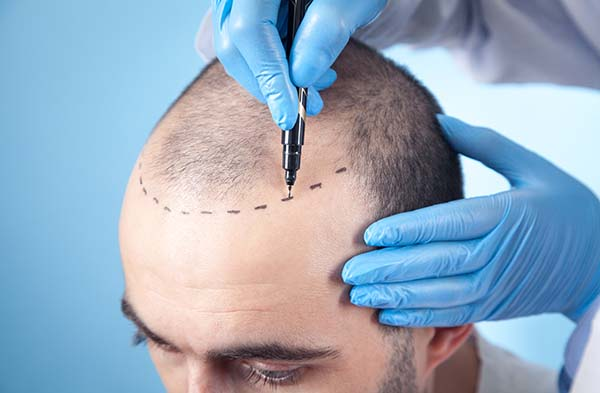
Modern hair transplant procedures begin with careful planning and hairline design
The First Documented Attempt
Japanese dermatologist Dr. Shoji Okuda publishes his work on using small grafts to restore hair to burn victims. His work was largely forgotten due to World War II.
Modern Hair Transplantation Begins
Dr. Norman Orentreich in New York performs the first successful hair transplant in the Western world. He introduces the concept of 'donor dominance' - that transplanted hair maintains its original characteristics regardless of where it's placed.
The 'Plug' Era
Large circular grafts (4mm) containing 15-20 hairs become standard. While effective, these 'plugs' often created an unnatural 'doll's hair' appearance. This era gave hair transplants a somewhat negative reputation.
Mini-Grafts Introduced
Surgeons begin using smaller grafts (mini-grafts with 3-8 hairs). This marks a significant improvement in creating more natural-looking results.
Micro-Grafts Emerge
Even smaller grafts containing just 1-2 hairs (micro-grafts) are introduced, allowing for more refined hairlines and natural-looking results.
Follicular Unit Transplantation (FUT)
Dr. Bernstein and Dr. Rassman revolutionize the field by introducing Follicular Unit Transplantation. This technique harvests and transplants hair in its natural groupings (follicular units), creating dramatically more natural results.
FUE is Introduced
Follicular Unit Extraction (FUE) begins gaining popularity. Individual follicular units are extracted one by one, eliminating the need for a linear incision and the resulting scar.
Robotic Hair Transplant (ARTAS)
The FDA approves the ARTAS robotic system for hair transplant surgery. This technology uses AI and advanced imaging to assist with precise follicle extraction.
DHI Gains Mainstream Adoption
Direct Hair Implantation (DHI) using Choi pens becomes widely adopted. This refinement of FUE allows for direct implantation without pre-made recipient sites, enabling greater density and control.
The Modern Era
Today's hair transplants achieve unprecedented natural results. Advances include improved instruments, stem cell research, PRP therapy as a complement, and increasingly sophisticated robotic assistance. Research continues into hair cloning and multiplication.
Key Takeaways
Results have dramatically improved.The "plug" era is long gone. Modern techniques create natural, undetectable results.
Less invasive options exist. FUE and DHI offer minimal scarring and faster recovery compared to older methods.
Technology continues to advance. Robotic assistance, improved instruments, and complementary therapies are making procedures better than ever.
The future is promising. Research into hair cloning and stem cell therapies may eventually provide unlimited donor hair.
Learn About Modern Techniques
Now that you know how far hair transplants have come, explore the different techniques available today to find the best option for you.